Construction
The general plan is as follows:
1. Initial implementation of the navigation logic in the software simulation. (~100% completed)
2. Boat design / blueprints - verify that any candidate hardware will fit correctly in the hull, etc. (~100% completed)
3. Need to resolve how the wind heading sensor will mount to the top of the mast. The main trick here is wire/connections that can freely rotate on the wind vane.. I am leaning towards having the vane spin freely with a magnet attached, and two hall effect sensors perpendicular to each other sensing the magnet direction. I will effectively be re-inventing one of these, which I have interfaced with before in a previous project. The main bummer is having to build and test this when it really feels like this should already exist! If anyone knows of an existing product, please let me know!
Note: I've determined that a wind vane is not the answer since apparent wind complicates things too much. Since I just need to know if the boat is going into a head wind, I will be using a magnet & sensor on the boom to determine if the main sail is stalled. (at least that's the current plan)
(~100% completed)
4. Build the boat. Initially, the only hardware that will go in it is the RC receiver and servo(s). The boat will start out as a typical, remote control boat to evaluate boat's performance (and modify if needed). (~100% completed)
5. In parallel to step 4, start ordering other electronic hardware. Order of purchasing will be something like: 2 or 3 channel radio control & servos, main board (leaning towards Arduino Pilot Mega), compass sensors, GPS, camera(s), ... ? (~100% completed) I currently have: Main microcontroller, 4 channel radio, massive 1/4 scale rudder servo, 2 1.3 megapixel cameras/video recorders, mast lights, GPS, Heading sensor, Wind Vane encoder. Eventually I'll get solar panels, rechargeable batteries, and more depending on scope, but for earlier test runs, non-rechargeable batteries will work.
6. Integration of hardware into software will also happen in parallel to steps 4 and 5 as hardware is received. (~100% completed)
Test Runs
1. The initial test runs will be effectively as a standard, remote control sail boat. (as mentioned in #4 above). This will likely take place at Alamitos bay as well as Belmont shore (within the breakwater) to see how the boat handles. One of the major concerns in testing on the ocean side is whether the scale of the boat handles well in rougher water. Depending on the results, this may require a re-design of the boat. (here's to hoping that isn't necessary!) (~100% completed)
Video:
 First Sail
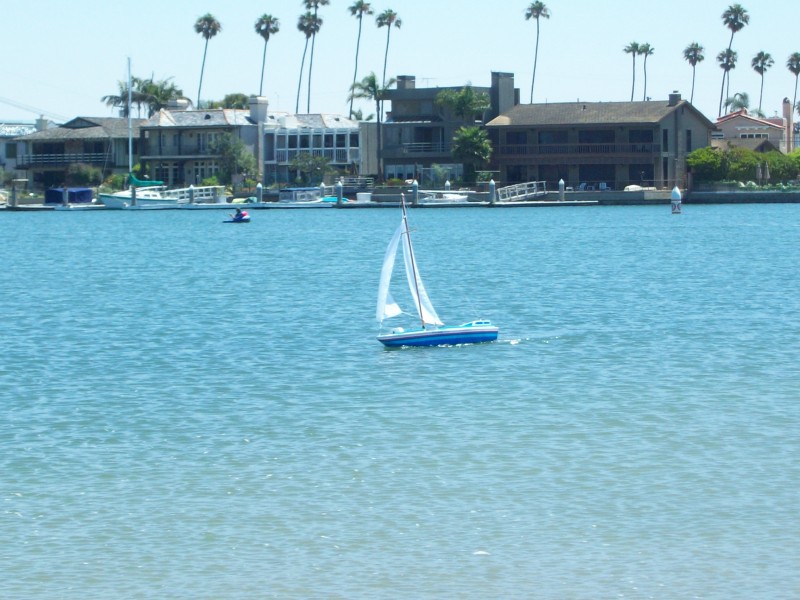

2. Once the 'unmanned' capability is in place, it will be initially tested as hybrid RC/autopilot. One of the channels on the RC allows to switch between autopilot and RC control. Additional channels will be used during RC mode to add/remove waypoints. For example, in RC mode, I will sail the boat around, and occasionally add waypoints of the boat's current position. After several points have been set, I can switch to autopilot mode and the boat should follow the same course I had just taken manually. (~100% completed)
Video:
Plot of course from log dataSample sailboat camera footage3. Several ocean side courses will be run through to see how the boat handles decent distances in rougher water. For example, the boat will be sent around one of the oil islands there inside the breakwater in Belmont shore. TODO
4. If tests in #3 go well, the next plan is to send the boat OUTSIDE the breakwater and back. If a success, the plan is to incrementally work towards a round trip to Catalina. (yes, I realize this is probably fantasy, but it would be awesome... and I will continue to push the boat further and further until the boat either sinks or makes it!!!) TODO
5. For now, this is as far ahead as should be planned. Catalina is a pretty ambitious goal for such a small boat that is likely to be stolen or simply lost at sea! In the unlikely event that things continue to go well, I would love to push the boat even further.. TODO